Why Is the United States Facing Its Current Dilemma?--Analyzing Trump’s Visit to China (Part III)

By exporting the U.S. dollar and outsourcing lower-efficiency manufacturing to low-cost nations, the United States long secured cheap tangible goods alongside substantial overseas capital returns. This has been a standard perk of financial hegemony. When the trade deficit grew too large, Washington could historically deploy financial mechanisms—such as forcing currency revaluations on major industrial nations—to rein it back in.
Today, this methodology no longer works.
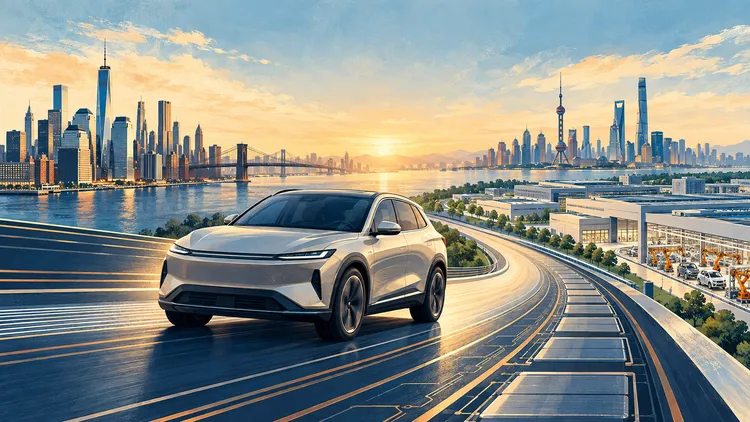
Over time, as industrial costs in Japan, Germany, and South Korea rose to a certain threshold, global manufacturing naturally had to seek out a new low-cost destination. China happened to be perfectly primed for this transition just as it got underway. It offered a vast pool of engineers, countless assembly line workers, virtually cost-free industrial land, and unimaginably low per-capita wages. It was the quintessential industrial manufacturing hub—offering both unparalleled production capacity and a sustainable, low-cost supply chain. Even today, the comprehensive cost of Chinese manufacturing remains incredibly low. (For context, even when Chinese electric vehicles are hit with a 100% markup for export to Europe, they remain half the price of European models with comparable specifications.)
The United States found this temptation impossible to resist, which was the primary driver behind Washington backing China's entry into the WTO. China executed its role flawlessly. Not only the U.S., but Europe as well, fully enjoyed the dividend of Chinese industrialization. In the early 2000s, China famously had to export roughly 800 million shirts just to buy a single Boeing or Airbus commercial jet. Even today, apparel on platforms like Shein is so inexpensive that consumers often forgo returns entirely, opting to simply discard items they no longer want.
Yet, nobody anticipated just how rapidly China would evolve. The very aircraft that once required 800 million shirts to secure can now be designed and manufactured domestically by China—even though core components like aero-engines still rely on imports. (This explains why the CEO of GE accompanied President Trump on this visit to China; they supply engines for Chinese aircraft and have committed to providing a steady, continuous supply of commercial aviation engines to the Chinese market).
China has transformed into a true industrial titan. From the absolute peak of the supply chain down to final consumer products, it can supply virtually every category of physical goods. While it may still fall short at the ultra-high-tech summit, its mid-to-high-tier goods are exceptionally competitive. This reality is the foundational driver behind China's historic trade surplus.
Suddenly, Washington realized that its time-tested playbook had broken down. Exporting dollars, purchasing cheap physical goods, and capturing overseas capital returns still functioned, but using financial tools to adjust the trade deficit failed completely. China sits outside the U.S. military umbrella, nor does it operate a completely open financial market. Forcing Beijing into a modern-day equivalent of the Plaza Accord is a near-impossible task. As a result, the U.S. trade deficit has marched relentlessly upward.
Concurrently, the United States continues to foot a massive bill to maintain the globalized order, funding global military deployments and exporting democratic values at an exorbitant cost. From an input-output perspective, this model has become fundamentally inefficient: the U.S. protects global trade networks only to absorb staggering trade deficit costs in return.
Consequently, we are seeing a strategic American retrenchment. President Trump wants Europe to shoulder its own defense costs and is reluctant to commit further direct aid to Ukraine. Right after this latest visit to China, Trump noted in an interview that providing military defense subsidies to Taiwan might be an incredibly bad deal financially.
Some label this global U.S. retrenchment as a "New Monroe Doctrine," but that misses the mark. Rather, it is a pragmatic recognition that the encirclement of China is hitting structural walls. Because America's industrial hollow-out has persisted for over 40 years, it simply cannot decouple from the supply chains of China and Chinese-owned factories overseas for physical goods. Imposing tariffs cannot magically or instantly conjure another massive, low-cost industrialized nation capable of replacing China. Instead, it merely accelerates the global footprint of Chinese enterprises, pushing them to set up factories worldwide—and, by extension, integrating Chinese finance across global markets.
Banning the export of cutting-edge technology and products like AI and high-end chips can certainly delay China’s high-tech ascent, but it does nothing to rectify the structural imbalances in consumer goods and trade.
The United States is confronting an unprecedented dilemma in its history. What move will it make next?
Stay tuned for "Analyzing Trump’s Visit to China (Part IV) — What Lies Ahead for U.S.-China Relations?"