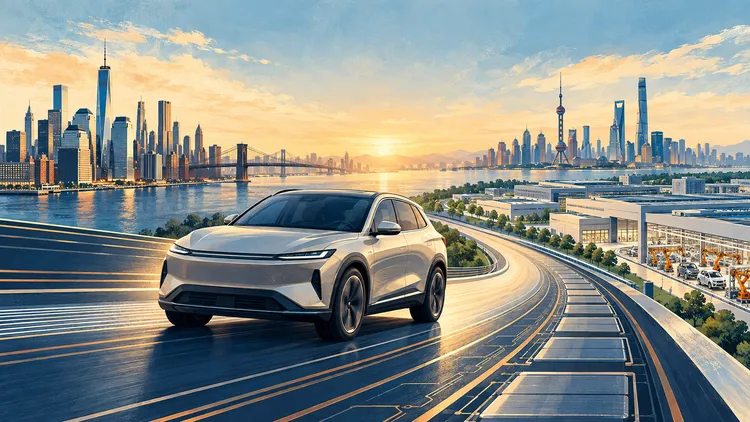
The Brutal Cost of America’s 9-Year China Strategy—China $1.18T Surplus vs U.S. $39T Debt
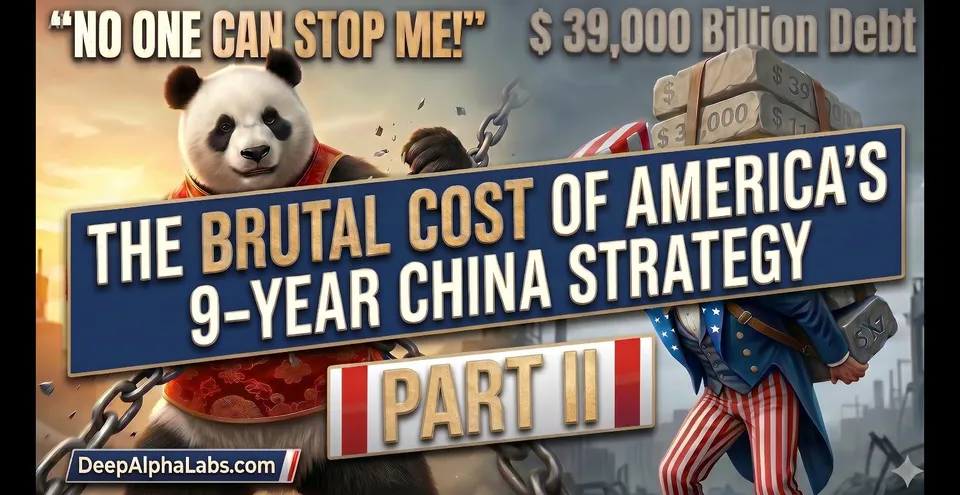
A U.S. president has not visited China for nine consecutive years. During this time, they have made every effort to halt China's development, initiating a comprehensive economic and technological blockade. Has it actually worked?
Nine years later, let us examine the reality on the ground today.
Despite facing comprehensive U.S. tariffs, China's trade surplus in 2025 hit a staggering $1.189 trillion (roughly 8.5 trillion RMB). This not only shattered China's domestic records but marked the first time in human history that a single nation's annual merchandise trade surplus exceeded the $1 trillion threshold. On the technology front, while a clear gap remains between China and the absolute cutting edge of semiconductor manufacturing (2nm–5nm), China has achieved massive scale in manufacturing 28nm chips and is aggressively breaking through 14nm technological barriers.
As current chip architecture hits physical limits, progress beyond 2nm is bound to slow down globally. In the next 5 to 10 years, the gap between China and the world's leading manufacturers may narrow to an acceptable margin. Furthermore, in sectors like memory storage, China’s catch-up speed has been phenomenal, steadily closing the gap year by year with South Korea’s Samsung and SK Hynix, as well as America’s Micron.
And how is the situation looking for the United States, the architect of this economic blockade?
By mid-March 2026, the U.S. federal debt officially crossed the $39 trillion threshold, climbing even higher than in previous months. This record-breaking debt load means the U.S. debt-to-GDP ratio sits well above 100%. For the full year of 2025, the total U.S. trade deficit in goods and services reached $901.5 billion, a nominal 0.2% drop from 2024. However, the specific deficit in goods hit a historic high of $1.2409 trillion, an increase of $25.5 billion (or 2.1%) over the prior year.
By April 2026, U.S. inflation climbed to 3.8%. The reality of these rising prices is felt acutely by everyday citizens on high-frequency consumer items like eggs, beef, and gasoline. Low-to-middle-income demographics are bearing the brunt of high interest rates and inflation. Credit card delinquency rates have surged to their highest levels since 2011, with the proportion of consumer loans (including credit cards) delinquent by at least 30 days holding at a high of roughly 4.8%, while auto loan delinquency rates have surpassed 6.8%.
The employment landscape for young American graduates in 2026 is similarly bleak. The unemployment rate for college graduates aged 22 to 27 holding a bachelor's degree hovers around 5.6%, while the underemployment rate (those working jobs that do not require a degree or are outside their field) sits at a massive 41.2%. Delinquencies and defaults on student loans have deteriorated significantly. Out of roughly 43 million Americans saddled with student debt, over 9 million have missed at least one payment. The delinquency rate for federal student loans overdue by 90 days or more has risen to approximately 9.4%, signaling mounting systemic risks in consumer credit.
Economic issues underpin all of America's internal challenges; when the economy stumbles, political instability inevitably follows. While ordinary citizens care about macro narratives and international trends, they ultimately voice discontent when the economy hits their everyday livelihood and spending power. That discontent translates directly to shifts at the ballot box.
To be fair, the current predicament facing the U.S. was not engineered by China.
In the short term, the direct catalyst is the war involving Iran, which caused oil prices to spike. This shock quickly rippled into higher gasoline prices, ballooning transportation costs, and increased expenses for chemical refining and fertilizers—which ultimately drove up agricultural input costs and grocery prices. With inflation ticking upward, the Federal Reserve is unable to cut interest rates, keeping borrowing costs high. Consequently, mortgages, car loans, and student loans have become significantly more expensive. High credit card interest rates further compound actual living expenses, causing real wages to shrink.
In the long term, the issue stems from the fact that capital generation in the U.S. financial sector became altogether too easy. Following its victory in World War II, the U.S. gradually constructed a position of global financial dominance—arguably a financial hegemony. For decades, leveraging the dollar’s status as the world's primary clearing and reserve currency, the U.S. could continuously issue Treasury bonds to export dollars globally in exchange for cheap, tangible goods.
This "effortless wealth" model made American capital heavily favor high-yield, virtual service sectors like finance, the internet, and law, resulting in the severe hollow-out of domestic manufacturing. Starting in the 1970s and 1980s, a vast portion of American industrial capacity migrated to Asia and Germany. Japan, Germany, and South Korea absorbed massive amounts of U.S. manufacturing capability, transforming into formidable industrial powers.
At the time, this architecture was remarkably stable because these nations were relatively limited in geographic and demographic scale, and they were fundamentally dependent on the U.S. military umbrella. Under American security protection, economic disputes were easily negotiated—which is precisely why agreements like the Plaza Accord were successfully executed.
Note on the Plaza Accord: Signed on September 22, 1985, at the Plaza Hotel in New York City by the U.S., Japan, the UK, West Germany, and France, this agreement intervened in foreign exchange markets. Its primary objective was to induce an orderly depreciation of the U.S. dollar against major currencies—particularly the Japanese yen and the German deutsche mark—to address the massive U.S. trade deficit.
Exporting dollars globally + offshoring industrial production to lower-cost nations + receiving cheap material goods + reaping overseas capital returns + using financial levers to adjust trade deficits: this combination was a beautiful loop. Americans who lived through that golden era undoubtedly look back with deep nostalgia; back then, the American Dream appeared at its absolute peak.
Today, however, that idealized American Dream seems increasingly out of reach.
Stay tuned for "Analyzing Trump’s Visit to China (Part III) — Why Is the United States Facing Its Current Dilemma?"