The 9-Year Boycott Ends? Why the US President Has No Choice But to Visit Beijing Now?Analyzing Trump’s Visit to China (Part I)
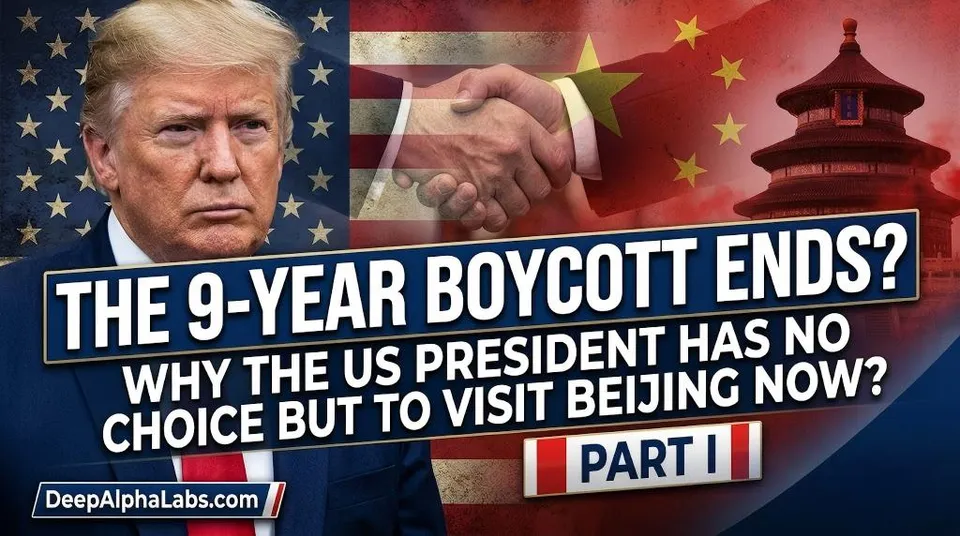
From May 13 to May 15, U.S. President Donald Trump conducted a three-day state visit to China. During this time, he held multiple summit meetings with Chinese President Xi Jinping, culminating in a series of cooperation agreements.
The last time a U.S. president visited China was also President Trump, back in 2017. A nine-year gap between presidential visits is an exceptionally rare interval in modern history.
In 1998, President Clinton visited China for nine days, traveling to five different cities.
Between 2001 and 2008, President George W. Bush visited China four times (2001, 2002, 2005, and 2008).
Between 2009 and 2016, President Obama traveled to China three times (2009, 2014, and 2016).
However, things began to shift when President Trump first took office; he visited China only once during his first term, in 2017. His successor, President Biden, did not visit China at all during his presidency—a complete break from a pattern that had held since the 1990s.
A nine-year absence of a U.S. presidential visit is highly unusual. Why did this happen, and what was the reality on the ground back then?
In 2017, measured by official exchange rates, U.S. nominal GDP stood at approximately $19.39 trillion, while China’s nominal GDP was around $12.25 trillion (roughly 82.71 trillion RMB). China’s total economy was about 63.2% the size of the U.S., ranking second in the world. However, when measured by Purchasing Power Parity (PPP), World Bank data showed that China’s GDP had reached $19.6 trillion, slightly eclipsing the U.S. to take the number one spot globally. At the time, China's GDP was still growing at an annual rate of 6.8%, compared to just 2.3% for the United States. History had never seen an adversary of this scale draw so economically close to the United States while maintaining such rapid growth.
It wasn't just the economic gap that was closing; China’s military was also developing at breakneck speed. In 2017, China had only one aircraft carrier in service. Today, China has three active aircraft carriers, giving it a baseline blue-water combat capability. The Chinese Air Force has also deployed a significant number of its fourth-generation J-20 stealth fighters. Even China’s older, less advanced J-10 fighter jets achieved a decisive victory during aerial dogfights between Pakistan and India, fully proving their real-world combat capabilities. Broadly speaking, few can dispute that China’s military power has reached the number two spot globally, second only to the United States.
Historically, the only country whose economy came close to rivaling the U.S. was Japan in the 1990s, when its GDP peaked at roughly 70% of the U.S. total. However, Japan’s military was entirely dependent on the United States and lacked independent strength.
On the military front, the Soviet Union came closest to rivaling the U.S., boasting numerous aircraft carrier groups, nuclear submarines, advanced third-generation fighters, a massive armored "steel torrent," and globally capable ICBMs. Yet, the Soviet economy was fundamentally weak, peaking at just over 40% of U.S. GDP. Even at that peak, it was rare to see Soviet-made consumer goods outside the USSR and Warsaw Pact nations. Today, by contrast, Chinese goods are ubiquitous across the globe—ranging from apparel and toys to electronics, electric vehicles, solar and wind energy equipment, cargo ships, and heavy machinery.
Facing a country that is catching up on all fronts—having itself held the title of the world's largest economy for over a century and its military leader since World War II—the United States adopted a strategy of near-total containment. On this front, the approaches of President Biden and President Trump remained remarkably aligned for a considerable period.
How have they attempted to halt China's development? Simply put, the strategy consists of two parts:
A: Deny China access to the critical inputs it needs.
B: Block the export routes for Chinese goods, which serve as its primary source of income.
Consequently, we witnessed a sweeping ban on exporting military hardware, tech components, novel scientific discoveries, cutting-edge microchips, and semiconductor manufacturing equipment to China. Even academic and professional exchanges among tech personnel were restricted. Meanwhile, the U.S.—historically the largest export market for Chinese goods—began levying steep tariffs across the board to choke off Chinese exports and limit China's trade surplus. Telecom equipment from Huawei and ZTE was barred from U.S. and European markets, alongside various other restrictive measures.
The United States has pulled out all the stops to halt China's development. Has it actually worked?
Stay tuned for "Analyzing Trump’s Visit to China (Part II) — Has the Strategy to Contain China Worked?"