The Competition and Connection of Two Global Engines ( US vs. China Economy Part 1 )
By Deep Alpha Labs — April , 2026
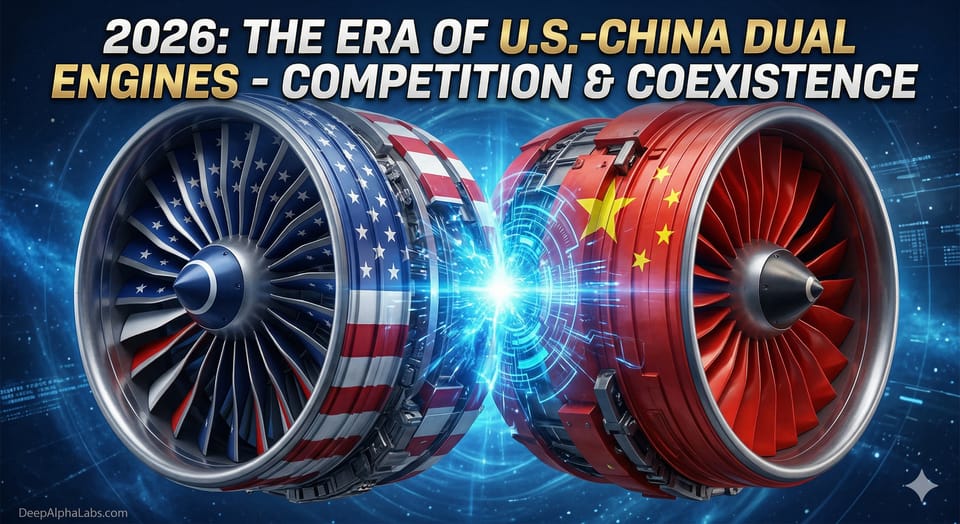
As we enter the second quarter of 2026, the global market consensus is clear: the world economy is driven by two, and only two, massive engines. While the United States and China share the same planet, they run on entirely different economic "operating systems." To understand the global business landscape of the next decade, we must look past the headlines and dissect the structural DNA of these two giants.
1. The Fundamentals: Land, Population, and the GDP Race
The physical maps of the U.S. and China are strikingly similar, covering approximately 3.6 million and 3.7 million square miles, respectively. However, the human stories told on this land are very different. China’s 1.4 billion people far outnumber the U.S. population of 340 million.
GDP Status and the Catch-up:
- U.S. Nominal GDP (2025 Est.): Approximately $29.5 trillion.
- China Nominal GDP (2025 Est.): Approximately $19.8 trillion (about 67% of the U.S.).
When measured by Purchasing Power Parity (PPP)—which looks at what money actually buys locally—China surpassed the U.S. nearly a decade ago. However, due to the strong dollar caused by geopolitical conflicts in early 2026, the moment when China overtakes the U.S. in nominal terms has been delayed. Current mainstream analysis suggests that China may not officially surpass the U.S. in nominal GDP until sometime between 2035 and 2040.
2. Industry DNA: Financial Sovereignty vs. Industrial Titan
The two nations have specialized in opposite ends of the economic spectrum:
- The United States (The Service Sovereign): With 81% of its economy in services, the U.S. acts as the world’s financial and intellectual headquarters.
- Finance & Tech: JPMorgan Chase and Goldman Sachs manage global capital, while Microsoft and Apple define global software standards.
- Pharmaceutical R&D: Companies like Eli Lilly, whose market cap is racing toward $1 trillion thanks to the success of GLP-1 drugs, prove that the U.S. still dominates the "0 to 1" phase of original innovation.
- China (The Industrial Titan): With 38% of its GDP in industry, China is the only nation in the world that possesses all 41 industrial categories listed by the UN.
- The BYD Example: By 2025, BYD’s global deliveries put immense pressure on Tesla. BYD is more than just a car company; it is a vertical integration monster—designing its own batteries and chips, and even operating its own fleet of car carriers. It is the ultimate symbol of China’s "1 to 100" execution power.
3. Cultural Logic: Individual Innovation vs. Organized Discipline
Why does the U.S. create OpenAI, while China creates the world’s most complete EV supply chain? It stems from deep cultural differences.
- The U.S. rewards the "Disruptor." Its culture prizes individual risk-taking and breaking the rules. This explains why the U.S. remains the birthplace of nearly every revolutionary technology.
- China excels at "Organized Discipline." Its strength lies in massive coordination, incremental improvement, and the scaling of complex hardware. When a goal is set, millions of engineers move in the same direction with military precision.
4. Shadows Behind Prosperity: Two Economic Dilemmas
Both systems are currently under extreme pressure, but for very different reasons.
The U.S. Dilemma: The Fragility of Financialization
The U.S. has become dangerously dependent on the "financialization" of its economy. Finance has become the #1 industry, followed closely by Real Estate (which is essentially a financial product made of bricks and mortar).
- The Risk Factor: An 81% service-based economy is incredibly fragile. As seen in the April 2026 Middle East crisis, when global supply chains are blocked, the U.S. finds it cannot "print" physical goods. Without an industrial base, any physical shortage quickly turns into out-of-control inflation.
- The Debt Cliff: With a national debt exceeding $34 trillion, the U.S. pays massive annual interest. While the global financial returns are huge, the moment the "Dollar Hegemony" is challenged, this financial castle faces a liquidity earthquake.
The China Dilemma: Overcapacity and Under-consumption
China’s problem is the exact opposite: production is too strong, while consumption is too weak.
- Overcapacity & "Involution": Because every province wants to be the "EV Capital," there is massive overcapacity. Many domestic firms are trapped in "Internal Involution" (Neijuan), surviving on razor-thin profit margins of less than 5%.
- The Consumption Gap: Why don't Chinese people spend more? It comes down to the "Cost of Anxiety." High child-rearing costs (while tuition is low, the 50% high-school enrollment cutoff forces parents to spend fortunes on tutors) and worries about healthcare and aging lead to a very high savings rate.
- The Deflation Shadow: Unlike the U.S. fighting inflation, China faces the risk of deflation. While the government is trying to stimulate demand by expanding medical insurance and encouraging births, the release of consumer spending remains slow.
5. Lessons of History vs. the Reality of 2026
History shows that the U.S. is an expert at neutralizing its "#2" rival. It used the arms race to bankrupt the Soviet Union and the Plaza Accord to stall Japan. These "financial big sticks" were highly effective at the time.
But in 2026, these tactics seem to be failing against China.
- The Reason: Finance is supposed to serve industry, not replace it. When the U.S. struck the USSR and Japan, the U.S. itself was still the world's factory.
- The Reality: The U.S. financial stick is less effective today because China holds the world’s physical supply chain. You can sanction a bank, but it is much harder to sanction the factory that makes the world’s antibiotics and electronics. Without a solid industrial foundation, financial hegemony becomes a river without a source.
Conclusion
The U.S. is a nation of high-value ideas and global financial power, but it is suffering from the hollowed-out pains of de-industrialization. China is a nation of massive production and an army of engineers, but it is struggling to find ways to make its citizens feel secure enough to spend and enjoy their wealth.
The standoff of 2026 tells us: the ultimate winner may not be the one with the highest GDP number, but the one who can fix their structural flaws before the next global shock hits.