
While the U.S. is mired in strife, China’s markets spring to life
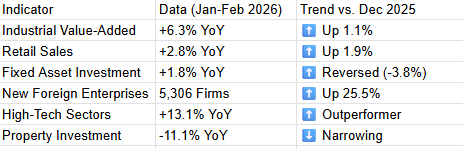
Recent data suggests the Chinese economy is successfully decoupling from its real estate slump and entering a phase of resilient recovery.
1. Industrial Rebound: Stronger Than Expected
The Data: In Jan-Feb 2026, value-added industrial output grew 6.3% YoY.
The Analysis: This significantly beats December’s 5.2% and market expectations of ~5%.
The Highlight: A clear structural shift is underway. High-tech manufacturing surged 13.1%, led by 3D printing (+54.1%), lithium batteries (+42.6%), and industrial robots (+31.1%). "New Quality Productive Forces" are now driving the momentum.
2. Consumer Recovery: A Notable Warm-up
The Data: Retail sales grew 2.8% YoY in Jan-Feb (up from a meager 0.9% in December).
The Analysis: While still in a "mild" recovery phase, the rebound is sharp, and consumer confidence is stabilizing.
The Breakdown: The "Holiday Economy" provided a major boost: Tobacco & Alcohol up 19.1%, Apparel up 10.4%. Long-term savings are finally being unlocked by a seasonal and structural shift in sentiment.
3. Investment Shifts: Changing the Engine
The Data: Fixed-asset investment turned positive at +1.8% YoY.
The Analysis: While the number seems small, the signal is massive, considering 2025 ended at -3.8%.
The Driver: Infrastructure investment jumped over 11%. Backed by the 1.3 trillion RMB special treasury bonds and the start of the 15th Five-Year Plan (2026-2030), the government is successfully using infrastructure and tech upgrades to offset the property decline.
4. Global Confidence: External Sentiment Reversal
The Data: 5,306 new foreign-invested enterprises were established in January alone, up 25.5% YoY.
Upward Revisions: Goldman Sachs raised China’s 2026 GDP forecast to 4.8% (from 4.3%); S&P Global hiked theirs to 4.4%.
The Logic: Despite geopolitical tensions, FDI from Germany (+86.6%) and Switzerland (+57.4%) is skyrocketing. The global supply chain still prioritizes the "efficiency-to-cost" ratio of Chinese manufacturing.
In me the tiger sniffs the rose.
Subscribe me for more data and insights.