
Two Ends Abroad: The Hidden Trap Inside Japan’s Global Empire
People usually look at Japan and see a contradiction. On one hand, it’s a country that’s obsessed with foreign markets. On the other, it’s the world’s biggest "creditor," owning more net foreign assets than anyone else, year after year.
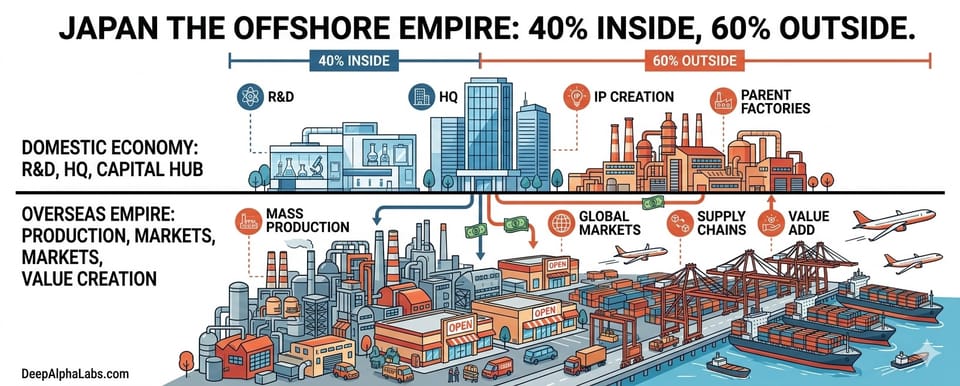
But if you look under the hood, there’s a simple, slightly scary truth: Japan’s economy has moved out. Everything—the production, the cash, the customers—is happening somewhere else. Japan itself has turned into a high-tech "headquarters." It’s the R&D lab, the "Mother Factory" for top-tier tech, and the control tower for global cash.
The actual wealth creation? That’s happening overseas. This "Two Ends Abroad" setup makes Japan incredibly good at global business, but it also makes them a slave to exchange rates and whatever is happening on Wall Street.
1. The Customer is Always... American.
Japan depends on foreign buyers more than almost any other major economy. If you look at their paycheck, about 38% of all the money Japanese companies make overseas comes straight from the United States. America isn’t just a partner; it’s the lifeblood.This is especially true for cars. More than a third of everything Japan sends to the U.S. is autos or parts. When America sneezes, the Japanese car industry catches a deadly cold. In 2025, when the U.S. hiked tariffs on imported cars, Japan’s data went off a cliff. Auto exports to the U.S. dropped nearly 23% in six months. Toyota’s profits tanked by 44%, and Mazda went from making millions to bleeding cash. It shows you how fast a policy change in D.C. can wreck a boardroom in Tokyo.
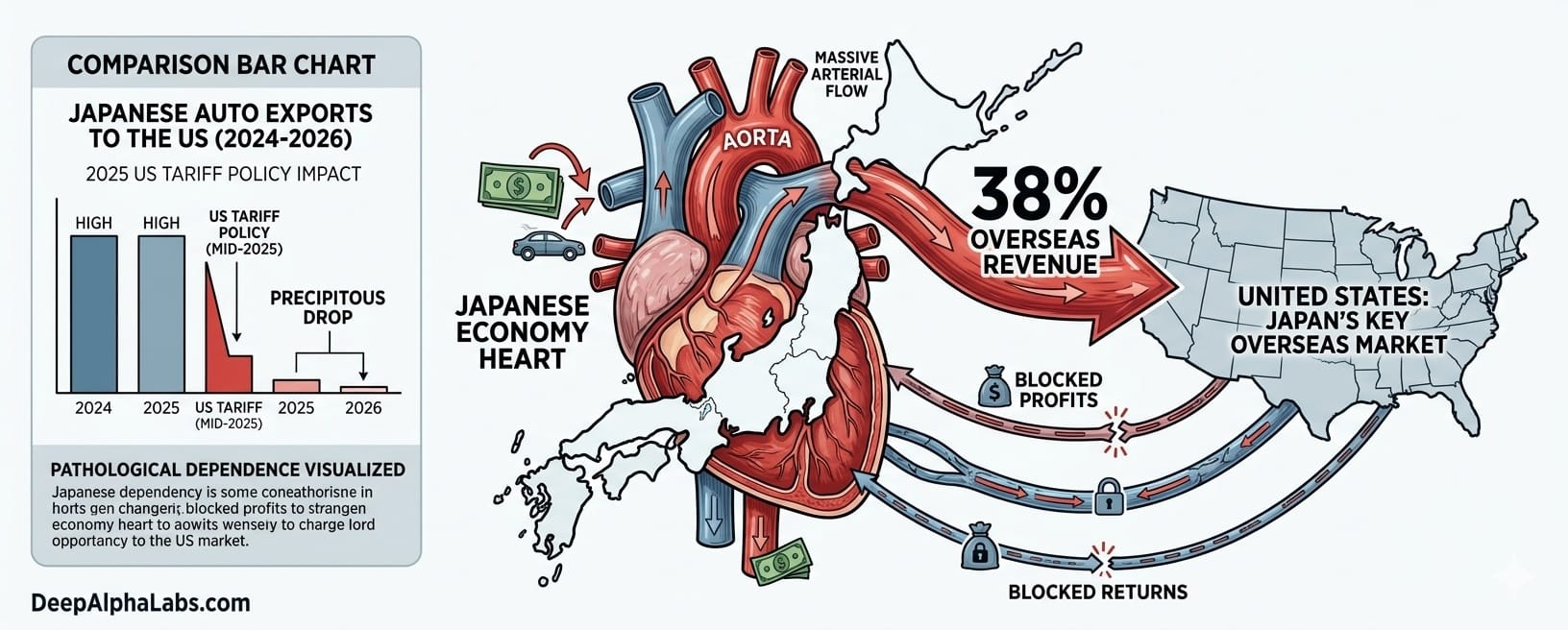
Overall, the "home" economy in Japan only makes up about 40% of their total activity. More than half of what they do relies on the rest of the world. In late 2025, because of those U.S. tariffs, Japan’s GDP actually shrank for the first time in a year and a half. Their home market just isn't big enough to cushion the blow when things go south overseas.
2. The Money Loop: Why the Riches Don't Come HomeIf the market dependence is the "what," the "Money Loop" is the "why." Japanese companies have spent decades building a massive web of assets abroad. By 2025, they owned over 400 trillion yen in net foreign assets.But here’s the kicker: the money stays out there. It’s a "broken loop."
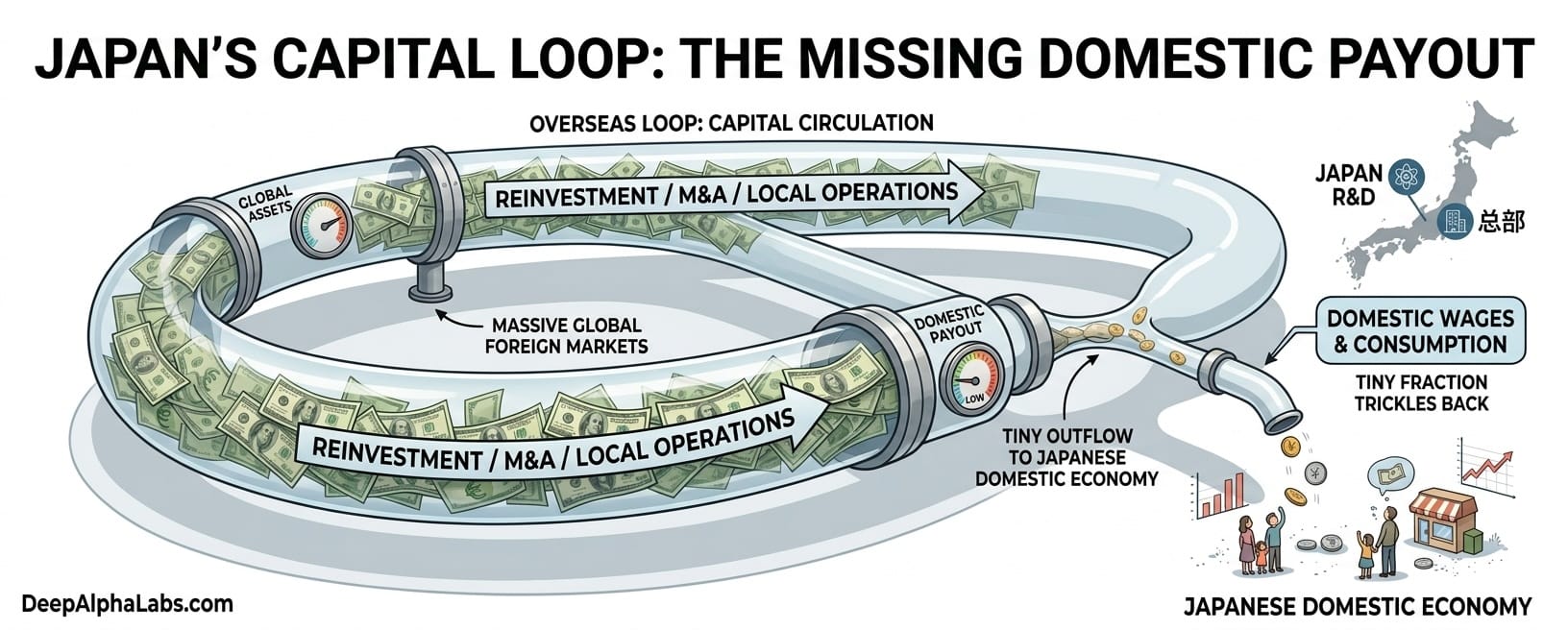
Japanese firms take the profits they make in the U.S. or Europe and immediately reinvest them in new factories or tech startups in those same places. They’ve built a self-sustaining cycle of cash that never touches Japanese soil.This means the regular Japanese person doesn't really feel the "win."
Even when we see headlines about Japanese insurance companies moving billions of dollars back into yen to chase higher interest rates, that’s just financial shuffling. It’s "hot money" looking for a quick buck, not the kind of corporate profit that leads to higher wages or better lives for the people in Osaka or Nagoya.
It’s a vicious cycle: the home market is too small to invest in, so the money stays out, which makes the home market even weaker.
3. The New Identity: Lab, Factory, and Control TowerSo, what is Japan’s "home" role now? It’s no longer the "World’s Factory" like it was in the 80s. Today, it plays three specific roles:
- The R&D Lab: This is where the "0 to 1" happens. The big brains at Sony or Fanuc stay in Japan to do the deep science. But once they figure out how to make a new chip or robot, the mass production happens in a factory in Ohio or Vietnam.
- The Mother Factory: Japan keeps the most "black box," insanely precise manufacturing at home. These factories are the gold standard. If a plant in Mexico breaks down, the "Mother Factory" sends the experts to fix it. But the jobs and the volume stay in Mexico.
- The Capital Hub: Tokyo is the control tower. The banks and insurance giants sit there and play the global markets like a piano.
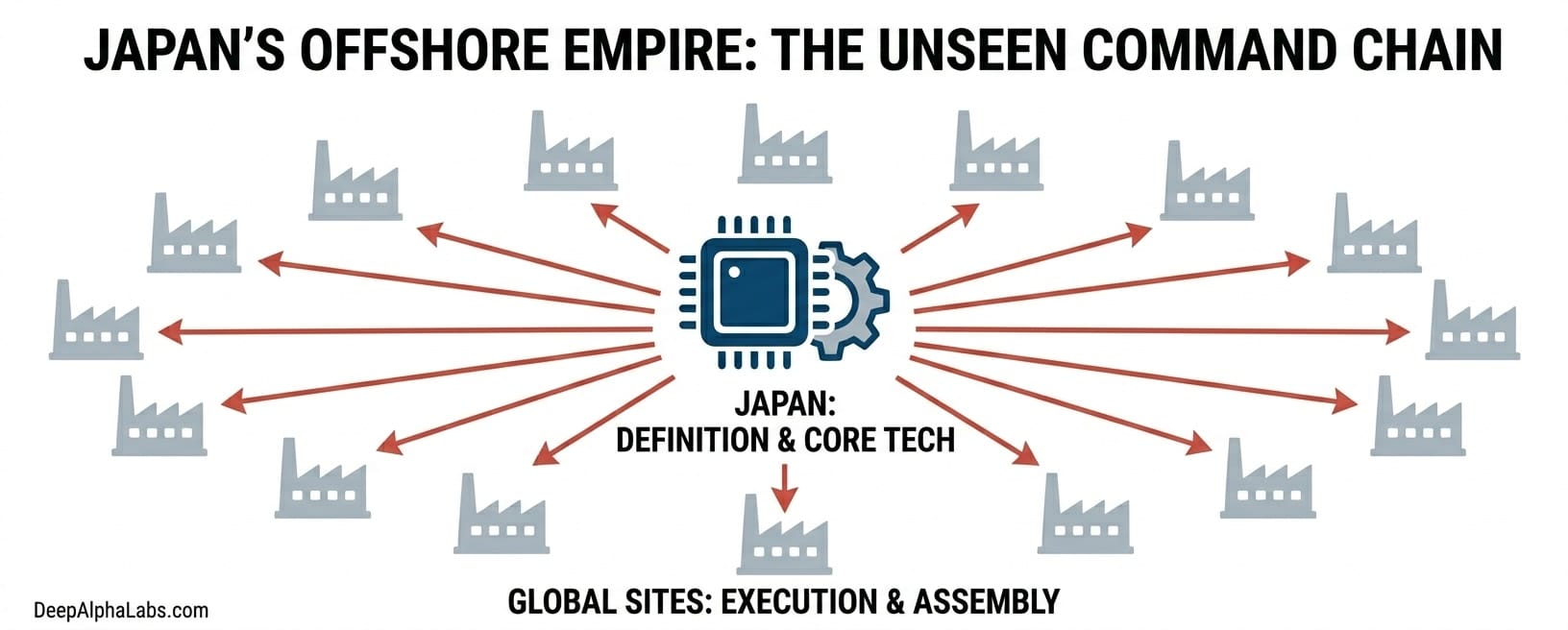
The problem? This "Headquarters Economy" is expensive to run but doesn't pay out to the locals. High-cost research stays in Japan, while high-profit growth happens elsewhere. The result is that corporate profits are booming, but workers' wages are stuck in the mud.
4. The Double Weakness: Currency and ChaosBecause Japan is so "spread out," it’s hyper-sensitive to two things: the exchange rate and global financial drama.You’d think a weak yen would be great for exports, right? Not anymore.
In late 2025, even after Japan raised interest rates, the yen stayed weak because people were worried about Japan’s massive government debt—which is over 250% of their GDP. This weak yen makes everything Japan imports (like food and fuel) way more expensive. It’s a "hidden tax" on the public that has kept inflation high for years.
Then there’s the "Wall Street factor." Japanese investors own over $1 trillion in U.S. Treasuries. As interest rates in Japan finally start to climb (hitting a 17-year high in 2025), that money might start flowing home. If Japan pulls its cash out of the U.S., it doesn't just affect the yen—it could rewrite the rules for global interest rates.
5. The End Game: Can They Break the Cycle?
The "Two Ends Abroad" model worked great during the golden age of globalization. But in 2026, with trade wars and geopolitical tension everywhere, it’s looking like a trap.When the U.S. raises tariffs, Japan has no "Plan B" at home. The government is trying to fix this by throwing trillions of yen at AI and semiconductors to bring growth back to Japanese soil. But breaking a thirty-year-old habit of "investing everywhere but home" is going to be a long, uphill battle.
In short: Japan has built a brilliant global empire, but they might have forgotten how to keep the lights on at home. The next few years will decide if this "Offshore Empire" can survive a world that’s increasingly pulling apart.
In me the tiger sniffs the rose.