The Iran Factor: Oil Spikes This Monday—Will the Stock Market Crack?
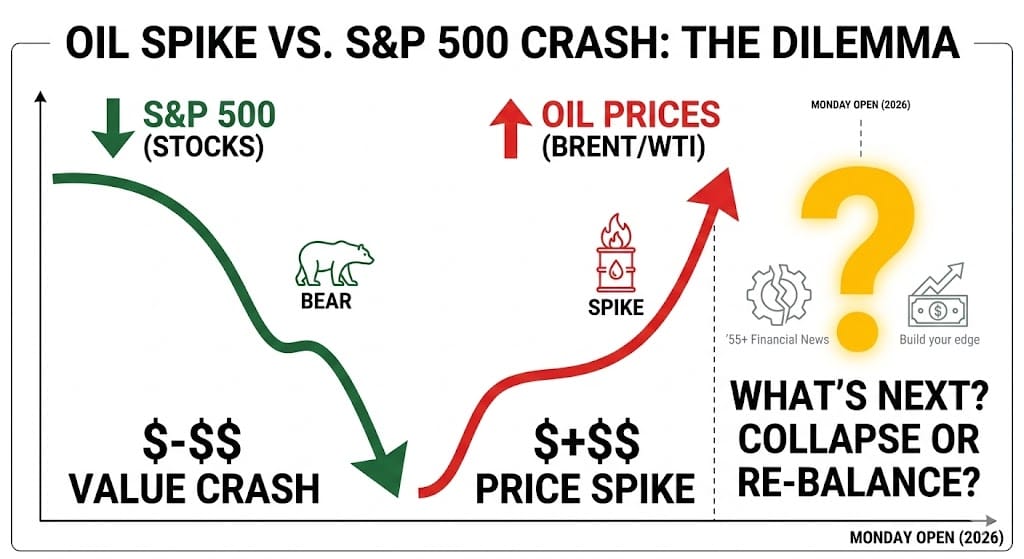
Monday’s open will be a moment of "Survival Repricing" for global markets.
The joint U.S.-Israel military strikes on Iran are no longer just breaking news; they represent a fundamental shift in geopolitical risk. While a gap-up in oil prices is nearly certain, the real question lies in the aftermath. To understand what happens next, we must look through the rearview mirror of history.
History Offers Three Scripts: When Iran Shakes the World
Over the last half-century, Iran-driven oil shocks have reshaped the fate of the S&P 500 in three distinct ways:
- 1979: The Islamic Revolution (The "Double Kill") One of the darkest periods for U.S. equities. Oil prices skyrocketed by 160%. The result? Hyperinflation and a Fed that cranked interest rates to 20%. The S&P 500 flatlined and entered a long-term bear market as liquidity evaporated.
- 1980s: The Iran-Iraq War (The "Delayed Bull") Though the war caused initial panic, non-OPEC supply (like the North Sea) eventually stepped in. Once the supply shock was mitigated, the cost pressure eased, and the stock market embarked on a massive multi-year bull run.
- 2011-2012: Nuclear Sanctions (The "Liquidity Shield") Oil prices hit $125, but the stock market didn't collapse. Why? Because the Fed was in a massive QE (Quantitative Easing) cycle. The flood of liquidity acted as a shock absorber, allowing stocks to climb despite rising energy costs.
The Current Dilemma: Profit Over Peace?
The trajectory of oil prices from here depends on the "appetite" of other major producers. Will OPEC+ (led by Saudi Arabia and the UAE) choose to expand supply to stabilize the global economy, or will they choose to harvest profits, enjoying the windfall of $100+ oil?
In today’s de-dollarization climate, the incentive for oil producers to rescue dollar-denominated assets is at a historical low. High oil may very well become the "new normal."
Conclusion: The Final Straw for the Camel's Back?
The real threat to the stock market today isn't necessarily oil—it is liquidity.
Unlike 2012, there is no QE safety net. Unlike the 1980s, global debt levels are at record highs. With tech valuations (like NVIDIA) already under pressure and the Fed’s hands tied by sticky inflation, the market is walking a tightrope.
The question remains: If oil sustains a move toward $100+, will it be the final straw that breaks the camel’s back for stock market liquidity?
We don't need to provide the answer yet. The answer will reveal itself in every tick of the tape this Monday.
Watch the gap. Stay sharp. 🐯🌹