
The Empire Under Pressure: The $39 Trillion Debt Abyss and the Global "Plan B"
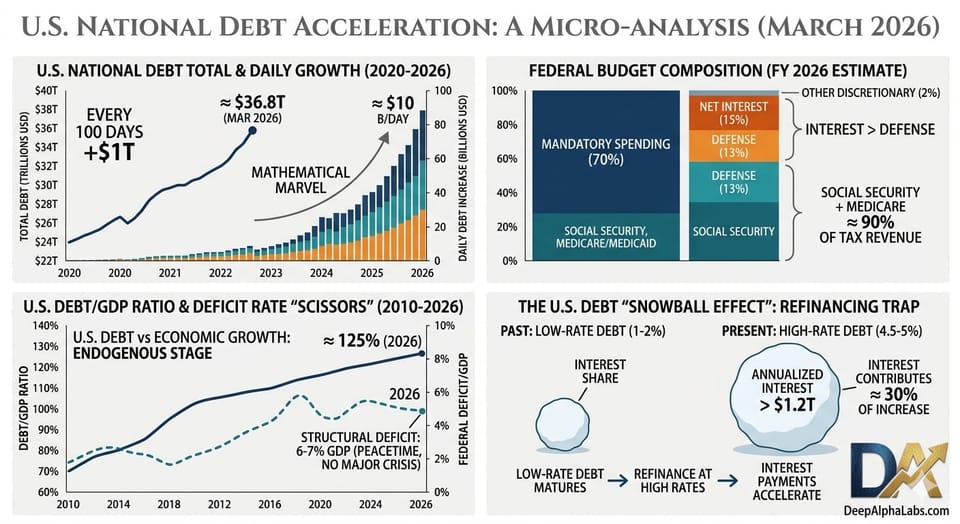
As of early 2026, the U.S. National Debt has officially surged past the $39 trillion mark. This is more than just a cold astronomical figure; it is a "mathematical marvel" in progress: U.S. debt is now increasing by $1 trillion every 100 days. When broken down to the micro-level, the "debt mountain" looming over every American household has reached $293,233.
I. Why Can't the Debt Be Stopped?
Current debt growth has entered an "endogenous phase," where the debt itself generates more debt:
- The Interest Snowball: The price of maintaining high interest rates to fight inflation is steep. Federal annual net interest payments have exceeded $1.2 trillion, surpassing the entire national defense budget.
- Locked Mandatory Spending: Social Security, Medicare, and statutory benefits account for 70% of the budget. Against the backdrop of an aging population, these are politically nearly impossible to cut.
- Geopolitics & Industrial Subsidies: Long-term consumption from conflicts in Ukraine and the Middle East, combined with massive industrial subsidies like the CHIPS Act, has kept the fiscal deficit at "wartime levels" of 6-7% of GDP.
II. Internal Echoes: Anxiety and "Self-Rescue" Across the U.S.
The U.S. is not reacting to this runaway debt with silence, though the country remains deeply divided:
- Washington Deadlock: Both parties call for deficit reduction, but in practice, Republicans refuse to raise taxes on the wealthy, and Democrats refuse to cut welfare. This leads to the debt ceiling becoming a recurring "political theater" every year.
- The "Gold Defense" of the States: This is a signal worth watching. Led by Texas and Utah, several states have recently passed legislation not only to remove sales taxes on gold and silver coins but even to propose the establishment of state-owned gold depositories. The core motivation is a fear of long-term dollar devaluation—an attempt to build an independent value floor for the state should federal finances fail.
III. Global Perspective: De-dollarization and "Defensive Hedging"
The international community's view of U.S. Treasuries is shifting from "the ultimate safe-haven asset" to a "systemic risk":
- Central Banks: "De-dollarization" is no longer just a slogan. While continuing to trim holdings of U.S. Treasuries, central banks worldwide are buying gold at the fastest pace in decades. As the only asset not linked to anyone else's debt, gold has become the ultimate hedging solution for global central banks.
- Alternative Systems: BRICS+ nations are accelerating the construction of settlement systems based on physical assets or multilateral local currencies, attempting to reduce reliance on the SWIFT system and dollar clearing.
- The "Unwilling" Bond: For major holders like Japan, a total sell-off is unrealistic as it would trigger a global financial tsunami. The current strategy is "reduce but don't add" or a slow divestment, shifting assets into more diversified fields.
IV. Conclusion: An Unsustainable Balance
Today, U.S. fiscal policy resembles a giant walking a tightrope. If every household needs over 140 years of net tax payments to clear the debt, then this money is, mathematically, unpayable.
The credit of the U.S. dollar currently relies on overwhelming military and technological dominance. However, when interest payments eventually consume the entirety of tax revenue, the Empire will face its ultimate test: choose severe fiscal austerity (social unrest), or choose to "dilute" the debt through hyperinflation (loss of credibility)?
In me the tiger sniffs the rose.
Subscribe me for more daily data and insights.