The Current State of U.S.-China Pharmaceuticals: Why Neither Can Leave the Other (US vs. China Economy Part 4)
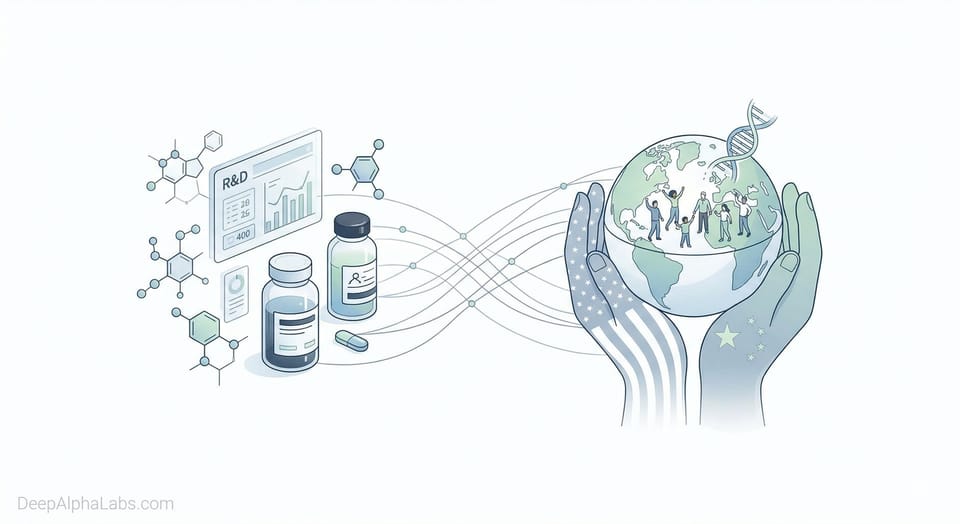
As we move into 2026 and look at the global medical industry, we see a very strange situation. Even though politicians on both sides talk loudly about "de-coupling" and "lowering risks," the labs and factories of the U.S. and China are more connected than ever. This relationship is no longer just about buying and selling; it is a "deep structural entanglement." As we analyzed in "Economic Dilemmas of the U.S. and China," this competition is a battle between "R&D efficiency" and "the power to pay." It has created a "scary balance" where neither side can walk away.
Misplaced Value Chains: A "Hard Requirement" for Both Sides
To understand why they cannot leave each other, we must look at how the value chain is split. Currently, the U.S. sits at the top of the value chain. With its strong science, rich capital markets, and expensive insurance systems, the U.S. controls the "pricing power" and the "original ideas" for new drugs. Data from 2026 shows that innovative drugs contribute 70% of the industry’s income in the U.S. This high-risk, high-reward model is the main engine for new medicine worldwide.
However, an engine needs fuel and parts, which is what China provides at the "waist and legs" of the value chain.
The Chinese medical industry is making a huge jump from making "copies" (generics) to becoming an "innovation powerhouse." In 2025 and 2026, the income from original drugs for China’s top 100 companies passed 50% for the first time. China is no longer just a base for cheap materials; it uses its "Engineer Dividend" to make research incredibly efficient. In the U.S., a $100,000 budget might only cover a small part of one researcher’s costs. In China, that same money can support 2.3 high-quality researchers. This "double speed, half cost" advantage makes China the world's most efficient lab.
The Truth About the Supply Chain: Not Just Materials, But the Foundation
People often think the U.S. can just switch to India for drugs. But in 2026, the cold truth is that India also cannot leave China.
Even though India is a top drug exporter, over 70% of its raw chemical ingredients (called APIs) still come from China. China has the world’s most complete chemical supply chain. It can find every chemical needed for a complex antibiotic in a single industrial park. According to recent stats, about 41% of the key starting materials (KSM) for U.S. drugs depend entirely on China.
U.S. lawmakers must face this reality: if they completely cut ties with China, American medicine cabinets could go empty in just a few weeks. This dependence isn't based on "friendship"—it's based on the massive cost advantage of China’s scale, which India or Southeast Asia cannot copy in five years, even with billions of dollars.
"China Speed": The Key to Beating the Patent Cliff
In the medical world, time is often more valuable than money. As U.S. giants like Merck and Eli Lilly face "patent cliffs" (when their old drugs lose protection), they desperately need new drugs to fill the gap.
This is where China’s "clinical execution" shows its power. Because of its large population and organized hospitals, a cancer drug trial that takes a year to find patients in the U.S. might only take three months in China. A 2026 McKinsey report stated that Chinese drug companies move from discovery to testing 50% to 70% faster than those in the U.S. or Europe.
This speed has made China a "mine" for new products. In 2025, the value of Chinese drugs licensed to global companies passed $130 billion, with 60% being high-tech treatments like ADCs. The U.S. provides the money and the brand, while China provides the tech and the speed. This model—"China Discovery + U.S. Clinical Trials + Global Sales"—is the core logic of the industry in 2026.
The Shadow of Competition and the Strength of Cooperation
Of course, the competition is fierce. From the BIOSECURE Act at the end of 2025 to stricter rules on clinical data, the "walls" between the two nations are getting higher. This forces Chinese giants like WuXi AppTec to build more factories in Europe and Southeast Asia to keep their global customers.
But at the business level, Wall Street investors and Boston scientists still fly to Shanghai and Suzhou all the time. The reason is simple: when facing cancer, Alzheimer’s, or aging, science is the only common language. The next big steps—like personalized cancer vaccines and "resetting" old cells—need both U.S. computer models and China’s massive manufacturing.
Conclusion: An "Inescapable Balance"
As we analyzed in "Economic Dilemmas of the U.S. and China," the relationship in medicine has become an "Inescapable Balance."
If the U.S. government forces a "divorce," the cost will be extremely high: drug prices for American patients could double, new cures could be delayed by years, and the quality of life for voters would drop. For the CEO of Eli Lilly or Merck, a partner who cuts research time in half and costs by a third is too valuable to lose, no matter how much politicians argue.
The reality of 2026 proves that medicine is one of the last forts of globalization. In this field, "de-coupling" is not just a financial loss—it is a man-made delay in human health progress. The fact that neither side can leave the other is not just about business; it is the most rational, though difficult, choice for humans fighting our common enemy: disease.