
Military Might May Not Win the U.S.-Iran War; Watch Political Talks for Oil Prices
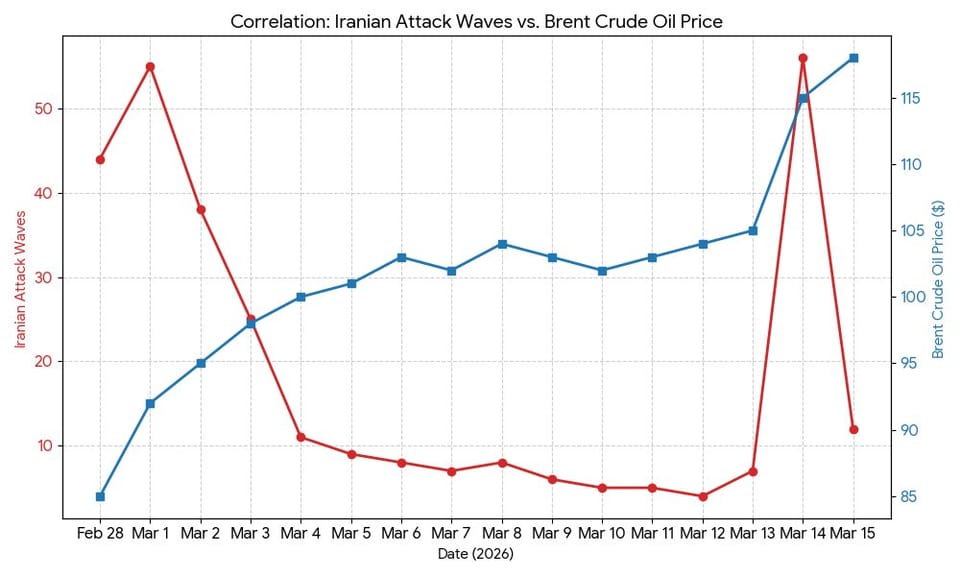
Iran’s military is mostly gone and its leadership is decimated. Yet, there is still no clear end to this war.
The Narrative: Iran’s Persistent Counter-Strikes (March 4 – March 15)
From March 4 to March 13, the war entered a "grinding phase." Even though the U.S. and Israel destroyed about 190 Iranian missile launchers, Iran did not stop. Instead, they changed their tactics. They moved away from large, easy-to-see attacks and started using small, hidden "guerrilla" teams.
March 4–5: Iran launched about 10 waves per day. They began using cluster warheads—missiles that break into many smaller bombs—targeting crowded areas like Ramla, Israel.
March 6–9: Attacks slowed down but became more dangerous. Iran tried to block the Strait of Hormuz to hurt the world's energy supply. During these days, they sent large swarms of drones toward the UAE and Saudi Arabia. While 95% were shot down, the fear alone caused oil prices to spike.
March 10–12: Iran focused on "precision strikes." Using new radar-seeking missiles (upgraded with Russian technology), they successfully "blinded" a U.S. THAAD radar station in the Gulf. This proved that even with fewer weapons, they could still hit high-tech targets.
March 13: Only 7 waves were detected. The U.S. Secretary of Defense said Iran's power was down by 90%, but that same night, an Iranian missile still made it through and hit a building in Shoham, Israel.
By the weekend of March 14 and March 15, Iran proved they were far from finished.
March 14 (The Surge): Iran launched a massive 56 waves of attacks in 24 hours. They used over 320 missiles and drones—the highest number since the war began. They targeted the Kuwait International Airport and major cities in Israel.
March 15: The pressure continued with 12 more waves. While most were blocked, these attacks showed that Iran's underground factories are still working. By keeping the region in chaos, Iran is forcing oil prices to stay high, which acts like a "tax" on every country in the world.
This chart confirms that we are not just looking at a military event, but a long-term energy tax on global manufacturing. If the "Attack Waves" (Red Line) continue to show these unpredictable spikes, the "Oil Price" (Blue Line) is unlikely to return to pre-war levels, favoring energy-independent hubs over energy-import-dependent ones.
Subscribe me for more data-driven alpha and macro insights.
In me the tiger sniffs the rose.