
Global Financial Fracture 2026: The Yen Tsunami and the Gold Mystery
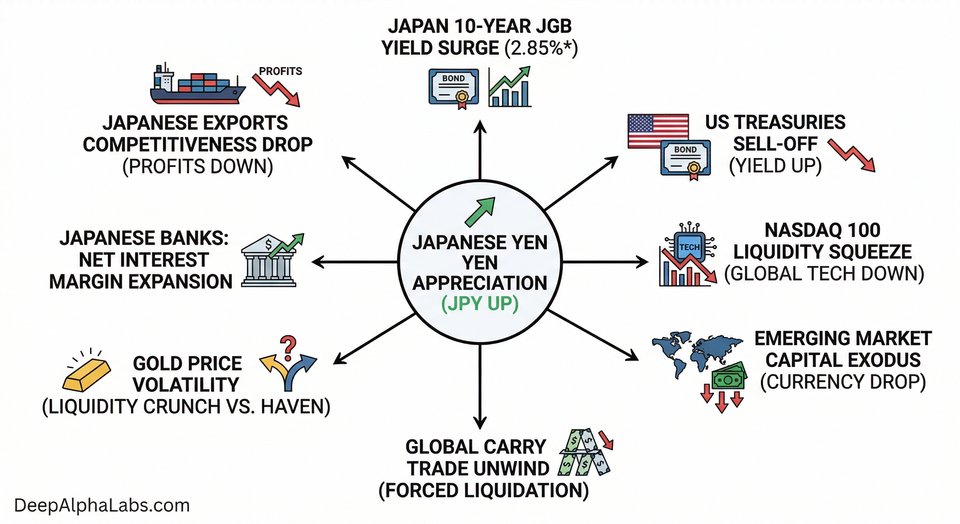
Foreword: As of late March 2026, the underlying code of global financial markets is being rewritten. With the Japanese 10-year Government Bond (JGB) yield surging to 2.85%, the twenty-year era of "cheap Yen" has effectively collapsed. Simultaneously, a wave of sovereign gold selling is clashing with intense global risk-aversion, pushing market participants toward an unprecedented crossroads.
Part I: JGB at 2.85% — The Global Liquidity "Vacuum"
1. Key Metrics:
- JGB Yield: Hit 2.85% (a 20-year high).
- Carry Trade Volume: Estimated global "hidden" positions between $2 trillion and $4 trillion.
- Capital Reversal Forecast: Analysts anticipate $500 billion to $800 billion could exit U.S. Treasuries and equities over the next 6-12 months.
2. Structural Logic:
Japan is no longer the "free ATM" for global capital. Previously, Japanese retail investors (Mrs. Watanabe) and institutions borrowed Yen at 0% to invest in the S&P 500 or emerging markets. At 2.85%, the risk-free rate combined with Yen appreciation expectations means the real return on domestic Japanese assets is beginning to outperform overseas holdings.
- Observation: This reversal creates a liquidity "drain" for global risk assets, particularly high-valuation tech stocks and cryptocurrencies that are highly sensitive to interest rate shifts.
Part II: The "Cover" and "Trap" of Yen Depreciation
1. Currency Status:
- USD/JPY: Trading violently within the 152 - 158 range.
- Depreciation Premium: The Yen has lost nearly 15% of its value against the USD over the past 12 months.
2. The Core Tug-of-War:
The current weakness of the Yen acts as a temporary cover for U.S. markets. Selling U.S. assets while the Yen is extremely cheap would result in massive foreign exchange (FX) losses for Japanese holders.
- The Trap: Once the Yen bottoms out—triggered by Bank of Japan (BoJ) intervention or a Fed pivot—it could ignite the "Yen Tsunami."
- The Calculation Model: If the Yen strengthens from 152 to 135, a Japanese investor holding U.S. stocks needs the S&P 500 to rise by 12.6% just to break even in Yen terms. If the market stays flat, the urge to "cut losses" on the FX side could trigger panic selling, further driving the Yen higher in a self-reinforcing loop.
Part III: The Gold Mystery — Sovereign Selling vs. Systemic Collapse
1. Selling Data (Survival-based Liquidation):
- Turkey: Sold approximately 42 tons (10% of reserves) in 60 days to cover energy bills that soared to $9.2 billion/month.
- Egypt/Pakistan: With monthly energy import gaps exceeding $2 billion, these nations are pledging or selling gold to maintain food and fuel supplies.
2. Risk Dynamics:
- Short-term Pressure: If global markets drop due to Japanese tightening, funds may sell profitable gold positions to meet Margin Calls, leading to a short-term "flash crash" in gold prices despite high risk-aversion.
- Long-term Support: Gold has decoupled from simple interest rate logic. It has become a physical anchor for the "anti-dollar" system, supported by strategic buying from the central banks of China, Russia, and India.
Part IV: Market Observations and Defensive Strategies
1. Structural Opportunities:
- Japanese Banking Sector: Rising rates directly benefit Net Interest Margins (NIM). Large Japanese banks (e.g., MUFG) are entering a phase of significant earnings reversal after a decade of stagnation.
- Strategic Currency Reversal: Market participants are closely watching the long-term pivot of JPY against the USD, which represents a re-pricing of global liquidity cycles.
2. Risk Mitigation:
- Portfolio Protection: Hedging strategies, such as Put Options on high-leverage tech sectors, are becoming standard as the "Yen funding tap" closes.
- Gold Accumulation Patterns: Observers note a shift toward "buying the dips" rather than chasing highs to counter the short-term volatility caused by sovereign selling.
Conclusion:
The market of 2026 no longer belongs to "growth chasers" but to "liquidity watchers." As the Yen shifts from outflow to inflow, every asset class globally will be slapped with a new price tag. Watch the 3.0% red line on JGBs; that may be the signal that the Tsunami has officially made landfall.