
American Economic Crisis 2026: Expensive Gas Tanks and Empty Wallets
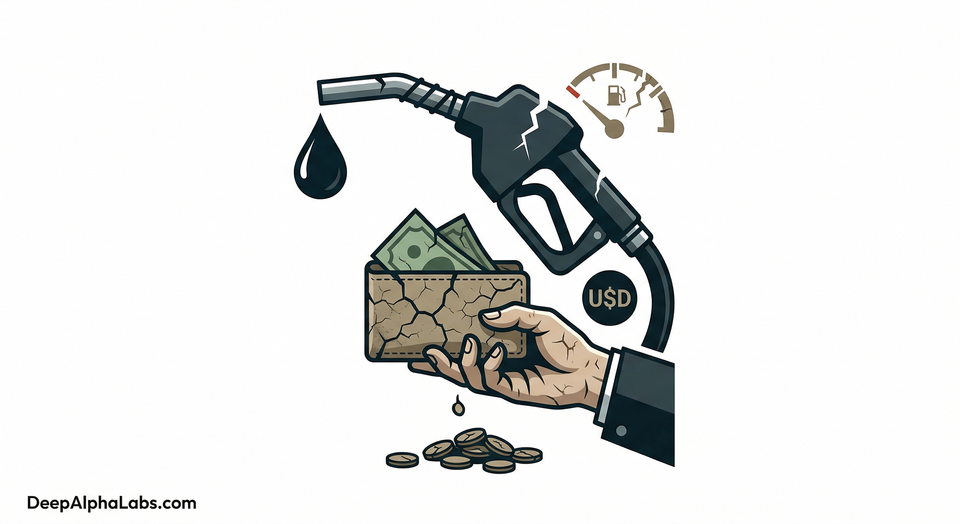
In 2026, the U.S. economy is like a high-performance sports car speeding through a thick fog. Even though the fuel gauge says there is still gas in the tank (energy reserves), the price is so high that the driver (the consumer) is afraid to step on the gas. Worst of all, our mechanics (shale oil companies) only care about their service fees (dividends); they have no interest in actually fixing the car (increasing production).
1. The "Gas Station Tax": A Guillotine for the Middle Class
People often say, "Gas prices are the only real-time tax rate in America." As WTI crude oil surges toward $120 per barrel due to the crisis in the Strait of Hormuz, the average U.S. gas price has blown past $4.0 per gallon (with California seeing a terrifying $6.00).
- The Collapse of Consumption: Every one-cent increase in gas prices pulls $1.5 billion out of Americans' pockets annually. For 80% of Americans, driving is a necessity, not a choice. When filling up the tank costs an extra $50 a week, the money meant for new sneakers in an Amazon cart or a Starbucks latte simply vanishes.
- The Data: In Q1 2026, discretionary spending (money spent on non-essentials) dropped by 4.8% quarter-over-quarter—the sharpest decline since the 2008 financial crisis.
2. Why Shale Oil Can’t Save America
People ask: "Isn't America energy independent? Why not just pump more?" This is the biggest pain point of 2026: shale oil is no longer the "swing producer" it used to be.
- Wall Street is in Control: Finance experts now run these oil firms. The mission for 2026 is "returning value to shareholders," not "drilling like crazy." CEOs prefer using record profits for high dividends and stock buybacks to keep stock prices up, rather than gambling on new wells with skyrocketing costs.
- The Skill Gap: Even if they wanted to drill, they can't find the workers. In the Rust Belt, the experienced drillers are aging out. Meanwhile, younger people would rather stay home and stream on TikTok than work in the dirt and heat of an oil field. This "skills gap" means that even with the temptation of $140 oil, production has hit a plateau (a flat line).
3. The "Echo" of Inflation: From Gas Tanks to Dinner Tables
$140 oil doesn't just make your commute expensive; it "pollutes" the price of every single product through the logistics chain. On the farm, everything—from diesel for tractors to petroleum-based fertilizers—has become pricier.
- Transport Costs in Every Item: In March 2026, the U.S. Fuel Surcharge for trucking hit an all-time high. This means the price of bread on Walmart shelves and tomatoes in local supermarkets is being pushed up by shipping costs.
- Secondary Inflation: The Federal Reserve (the Fed) hoped inflation would drop to 2%, but the energy fire has pushed CPI (Consumer Price Index) back up to 4.2%. As a result, the 4.5% high-interest rate has become "permanent." Mortgage and auto loan rates remain stuck at highs; young people can’t afford homes, and fathers can't afford to trade in the family car.
4. The Debt Trap: Interest over Education
The interest payments on U.S. national debt have now officially surpassed the federal education budget. While no one expects college to be free anymore, current student loans have become a heavy chain around the necks of the youth. The government is spending more on "past mistakes" (debt) than on "future potential" (students).
Conclusion: A Long Year Ahead
2026 is brutal. It isn't even April yet, and I already find myself wishing that 2027 won't be this hard.
In me the tiger sniffs the rose.